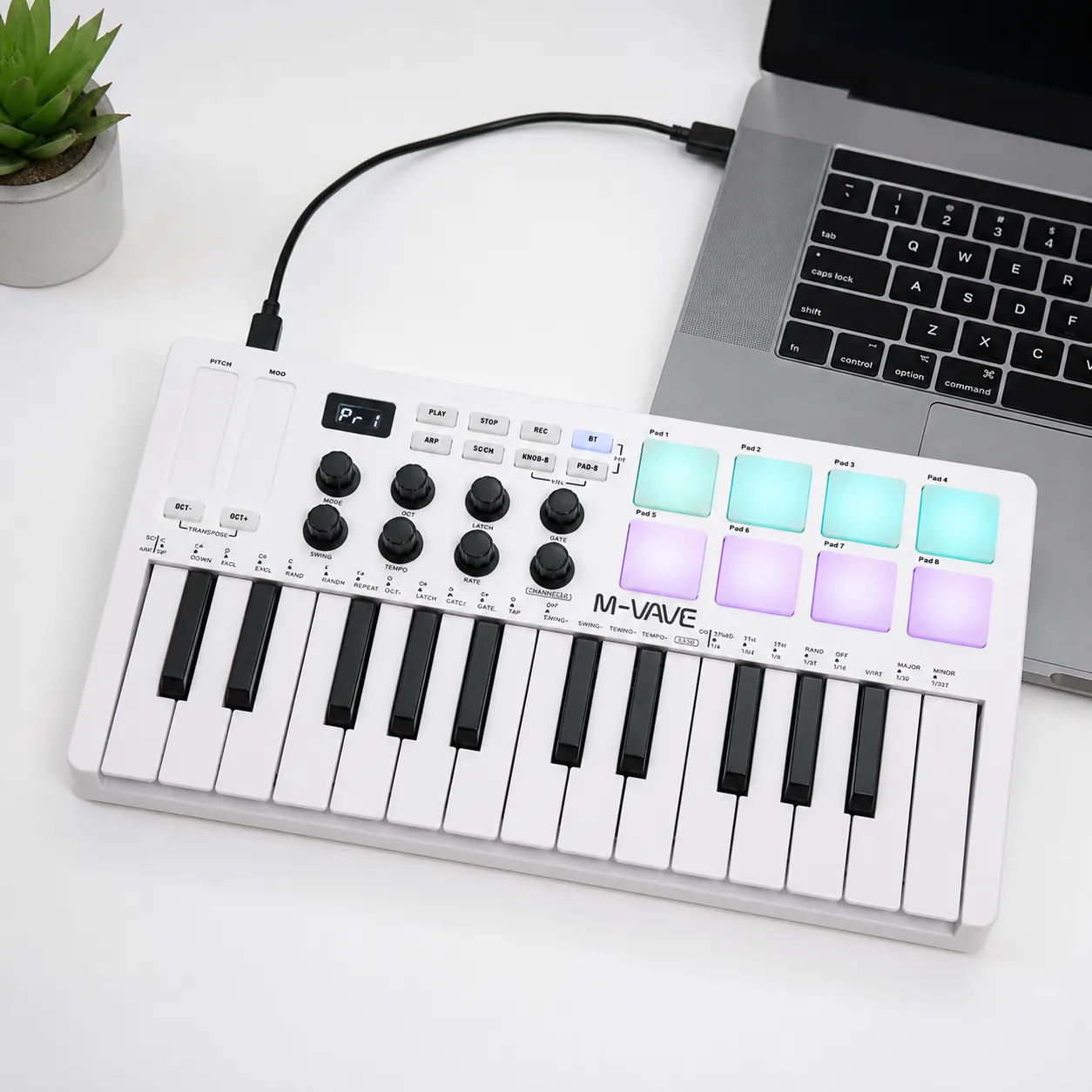
Short answer: Twenty-five keys are enough when you mainly record one musical idea at a time: a bass line, a short melody, a synth hook or a compact chord part. They become less comfortable when you want two-handed playing, wide voicings or piano-style practice without repeated octave changes. The M-VAVE SMK-25 White is documented as a 25-key MIDI keyboard controller with an ABS material listing. That confirms its category, not a complete set of controls or software features. Compare the key range with your actual projects, then check every missing compatibility detail before treating the compact format as the answer.
When 25 keys are enough
A compact layout earns its place when your project is built in layers. You might record a bass line, stop, move the range or edit a note, then add a lead phrase and a chord part separately. In that workflow, the controller is an input surface and the DAW remains part of the instrument. Twenty-five keys can be enough because you do not need every part available at once.
The same logic suits a small UK desk. A controller that remains within reach beside a laptop may be used more often than a larger keyboard that has to be stored before every session. That is a practical use observation, not a promise about this product's dimensions: the manufacturer does not specify its footprint, so confirm the physical fit from the current listing.
| Your main workflow | 25-key verdict | What to verify |
|---|---|---|
| Bass, lead or short hook | Often a sensible compact starting point | Computer, DAW and connection requirements |
| Layered chord and melody sketches | Possible when parts are recorded separately | Comfort with editing and changing register |
| Two-handed keyboard playing | Likely to feel restrictive | A larger documented playing range |
Where the range becomes a problem
The compact format becomes awkward when the musical idea itself needs more room. Wide chord shapes, two-handed arrangements and parts that cross several octaves can turn octave changes into a repeated interruption. You may still complete the work, but the controller is no longer reducing friction for the task you care about most.
It is also a mismatch when you expect a standalone instrument. The product is identified as a MIDI keyboard controller, and the manufacturer does not specify built-in sounds or speaker output. Do not assume that pressing a key will make sound without suitable software and the required connection. If that is central to your plan, select a product whose standalone behaviour is documented.
- Open two recent projects and note the range of the parts you usually play.
- Mark whether each part is one-handed, compact or regularly spread across octaves.
- Decide whether you are comfortable recording in layers and editing in the DAW.
- Reject the compact format if the repeated job is piano-style playing rather than note entry.
The confirmed M-VAVE boundary
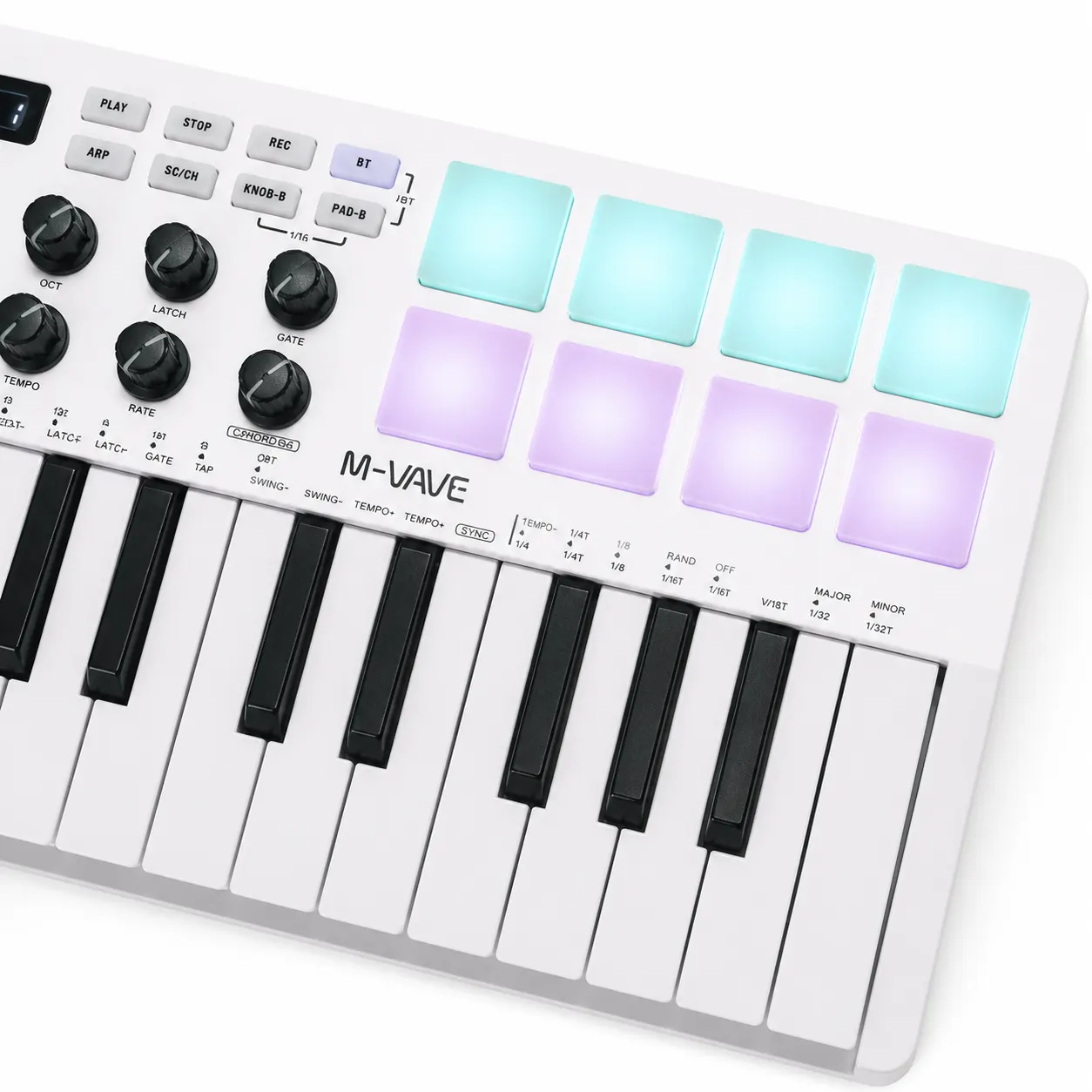
For the M-VAVE SMK-25 White, the documented anchors are the model name, 25-key MIDI keyboard category, SMK-25 colour configuration and ABS material. Those facts are enough to compare category fit. They are not enough to compare key action, velocity behaviour, controls, connectivity, software bundles, tablet use, dimensions, weight, latency or durability.
That boundary matters because compact controllers are often shown in broad music-production content. A review of another model can mention pads, knobs, transport buttons or automatic mapping without those features applying here. The manufacturer does not specify them on this product page, so the safe comparison is category and use case, not an imagined feature list.
- Confirmed: M-VAVE SMK-25 White selected product.
- Confirmed: 25-key MIDI keyboard category.
- Confirmed: SMK-25 selected colour configuration and ABS material.
- Unconfirmed: dimensions, key action, controls, software, connection details and standalone sound.
A fair choice against 49 or 61 keys
Compare sizes by the job that will happen most often. Twenty-five keys favour compact note entry and layered production. A larger keyboard may favour wider playing and fewer range interruptions, but it also needs a suitable surface and a place where it can remain usable. Do not buy extra keys merely because a larger number sounds more capable.
If you are undecided, write a short decision note: the parts you create, whether you play with one hand or two, whether the controller must stay on a small desk, and which missing features would be deal-breakers. Then check the live product page. That process keeps the choice tied to evidence instead of a generic size ranking.
Related guides and product details
Twenty-five keys are enough for compact, layered DAW work when the controller's limits match your parts. They are not a substitute for a larger playing surface. Buy the M-VAVE SMK-25 only after the 25-key workflow and the unlisted setup details both fit. Read MIDI Keyboard Controller for Beginners in the UK for related guidance. Read Is a 25-Key MIDI Controller Beginner Friendly in the UK? for related guidance. Review the documented specification on the M-VAVE SMK-25 White 25-Key MIDI Controller product page before ordering.
Sources and safety context
- Supports the M-VAVE SMK-25 product identity and the listed 25-key, colour and material facts. Current Backldrum product page.
- Provides general MIDI context without adding unsupported specifications to this controller. MIDI Association: MIDI 1.0.